
David Capablanca and the Craft of Short Selling
David Capablanca went from architect to self-taught short seller, bringing a structural engineer's eye for weakness to the markets. His firm Fugazi Research is 9 for 9, every target down at least 25%.
Activ8 Newsroom • February 10, 2026
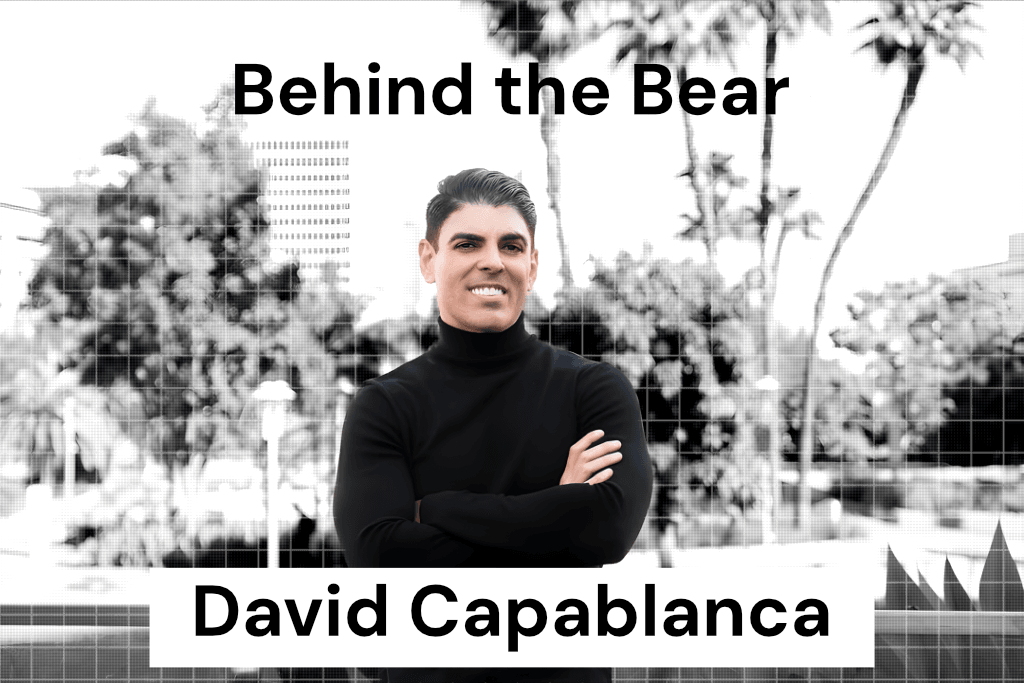
Behind the Bear
In this series, we profile the key players shaping the activist short selling landscape. From researchers and fund managers to data analysts and legal experts, we go deep with the people uncovering fraud, exposing manipulation, and driving transparency in public markets.
We sat down with David Capablanca, an architect turned short seller and author of the forthcoming book Short Selling Master.

Before markets, before short selling, before research reports, David Capablanca was trained to think in constraints.
Architecture, as he describes it, is not about aesthetic ambition first. It is about structure—understanding which elements carry weight, which assumptions are fragile, and how systems behave under stress. Buildings do not fail because they look wrong; they fail because something fundamental was misunderstood.
Capablanca carried that discipline with him when he entered markets in his early thirties, without institutional backing and without a traditional financial pedigree. Trained formally as an architect, with a master's degree in the field, he did not arrive through a trading desk or a bank training program. He arrived by teaching himself, with his own capital at risk, building process through repetition and loss rather than inheritance.
You can be directionally right and structurally wrong—and the market will not forgive the difference.
The Craft of Short Selling
Capablanca is careful not to romanticize short selling. He describes it as work—methodical, repetitive, and exacting. The edge is not cleverness, but preparation. Speed matters, but only after the groundwork has been done.
Long before a trade becomes possible, he operates within a narrow universe shaped by constraint. Entire categories are excluded outright. What remains is a defined field where experience, pattern recognition, and discipline intersect.
Qualitative work begins with people and incentives. It involves understanding who stands to benefit from a move and why—executives, board members, financiers, and other recurring actors. Past behavior matters, as do relationships, prior ventures, and patterns that repeat across companies and cycles. This work is investigative and contextual, often surfacing risk before it becomes visible in price.
Quantitative work begins with exclusion. Entire markets and structural profiles are ruled out before any opportunity is considered. Constraints around size, liquidity, ownership, and price behavior narrow the field until only a small, manageable universe remains. The numbers impose constraints—refined through trial and error—that maximize the probability of favorable outcomes over time.
When qualitative and quantitative elements converge, execution becomes decisive. The emphasis is not on prediction, but on confirmation. And on speed. If the conditions align, the trade becomes viable immediately. If they do not, he moves on just as quickly.
Learning from the Outside
Institutional finance is designed to produce consistency. Training programs, risk frameworks, and career paths teach large numbers of people to see markets in broadly similar ways. That structure has advantages, but it also narrows the range of acceptable thinking.
Capablanca developed independently of this. Without a predefined playbook, trial and error became his primary teacher. Losses were not theoretical, and wins were not abstract. Each outcome fed directly back into process, reinforcing what worked and eliminating what did not. Over time, this feedback loop produced a framework that was personal, but tightly disciplined.
That independence is reflected in how he works today. Rather than reacting to consensus narratives, he relies on systems he has tested under real conditions. Rules are followed because they have survived pressure, and any deviation is examined closely.
The result is a style that prioritizes repeatability. Capablanca is less interested in being early than in being prepared. The goal is not to outthink the market in the abstract, but to operate within a structure that limits error and compounds advantage over time.
Structure, Not Instinct

Capablanca does not speak about markets as someone who grew up fluent in them. He is explicit about how much he had to learn, and how late that learning began. Basic concepts that others take for granted were once opaque to him. That memory has not faded.
It shows up in how he talks. Capablanca is quick, animated, and expansive, moving rapidly through ideas, examples, and stories. During our conversation, he was open about mistakes, generous with context, and candid about the people who helped him early on. He did not speak as someone guarding a position, but as someone who remembers what it felt like not to understand.
That orientation has carried into how he works today. Capablanca has channeled his emphasis on financial literacy and disciplined process into Friendly Bear University, where he focuses on teaching short selling and market structure, and Fugazi Research, where he publishes short-selling research and analysis.

His forthcoming book, Short Selling Master: Proven Strategies from a High-Stakes Day Trader, will be released by Harriman House on August 4, 2026. It represents the culmination of years refining a process that started with trial and error and evolved into something systematic.
Capablanca's success is not hypothetical. Since launching Fugazi Research in June 2025, every single published short thesis has resulted in significant stock declines. The track record speaks for itself. Capablanca has emerged as one of the standout activist short sellers over the past year, combining rigorous research with precise execution.
Architecture offers the final parallel. The best structures do not announce themselves. They simply remain standing.
Fugazi Research Track Record

Fugazi Research focuses on small-cap names with specific structural characteristics: questionable promoters, aggressive accounting, opaque financials, and price action that suggests retail distribution. The reports are detailed, sourced, and designed to withstand scrutiny. Since June 2025, every published thesis has played out.
9 for 9 — Every published thesis has resulted in a stock decline of at least 25%
Report Timeline
About David Capablanca
David Capablanca is a short seller, researcher, and educator. He is the founder of Friendly Bear University, a short-selling academy focused on market structure, risk management, and financial literacy, and Fugazi Research, where he publishes short-selling research and analysis.
Short Selling Master: Proven Strategies from a High-Stakes Day Trader (Harriman House) releases August 4, 2026. Preorder now.

Notable: SMX dropped 94.5% following Fugazi's December report—one of the largest single-report declines in the activist short space in 2025. The thesis identified promotional activity and revenue recognition concerns that the market ultimately validated.