
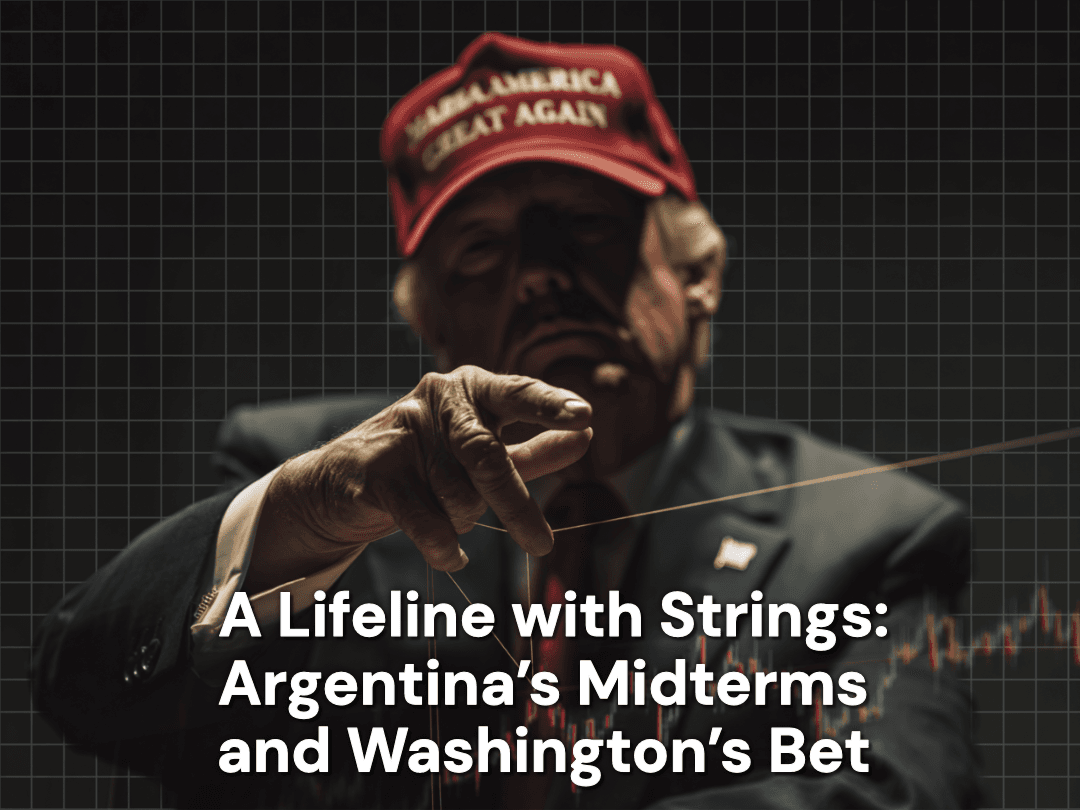
A Lifeline with Strings: Argentina’s Midterms and Washington’s Bet
What was meant to steady markets instead reminded investors how quickly foreign policy and domestic reform now intertwine. The package ties Argentina's short-term liquidity directly to political alignment in Washington. Critics on both sides of the equator see the risk: U.S. farmers call it an 'America-last bailout,' while Argentine opposition leaders call it 'conditional sovereignty
Activ8 Newsroom • October 24, 2025
Bottom Line Up Front
- Argentina's Sunday midterms will test President Milei's reform agenda, with Trump making a $40 billion U.S. support package explicitly conditional on electoral success
- Trump's political conditionality rattled markets that had initially rallied on the deal, reintroducing devaluation and capital flight risks
- Key Argentine assets like YPF, Banco Macro, and GGAL face immediate downside if Milei's coalition loses ground; MercadoLibre remains more insulated due to regional diversification
- The peso is widely expected to weaken post-election, but remains nearly impossible to short directly due to capital controls—leaving equity proxies and NDFs as the main institutional hedges
Politics as Collateral
Argentina votes this Sunday in legislative midterms that will determine whether President Javier Milei’s free-market experiment keeps momentum, or stalls in gridlock. The president himself isn’t on the ballot, but his austerity program is. After a string of defeats, veto overrides, decree limits, and a provincial loss in Buenos Aires, investors are watching whether the reform story still has legs.
Earlier this month, the Trump administration announced a $20 billion currency-swap line with Argentina’s central bank and floated another $20 billion in private financing. The move looked like economic support, until President Trump made it political.
“If he wins, we’re staying with him. And if he doesn’t win, we’re gone,”
Trump said at the White House, warning that the U.S. would not “waste our time” if Milei’s party fell short.
The remark rattled Argentine markets that had been buoyed by the deal only days earlier. Stocks reversed gains, the peso weakened, and traders began pricing in the risk that U.S. backing could evaporate with a poor result.
Politics Trades Like an Asset Class
What was meant to steady markets instead reminded investors how quickly foreign policy and domestic reform now intertwine. The package ties Argentina’s short-term liquidity directly to political alignment in Washington. Critics on both sides of the equator see the risk: U.S. farmers call it an “America-last bailout,” while Argentine opposition leaders call it “conditional sovereignty.” Either way, the lifeline now behaves less like aid and more like a political instrument.
A strong showing for Milei’s coalition could briefly restore confidence; a weak one could trigger another bout of devaluation and capital flight. In Latin America, these micro-political turns routinely drive macro outcomes. The fundamentals may look fine on paper, but policy visibility—not cash flow—decides the trade.
Market Watch: Assets in Focus
For traders watching the fallout, the ARGT ETF offers the cleanest proxy for Argentine exposure. It’s heavily concentrated, with a few holdings accounting for most of the movement. Among the top names:
- YPF Sociedad Anónima (10.3%) — The state-linked oil and gas producer trades as a referendum on Milei’s reform credibility. Any hint of subsidy reinstatement or export-tax change hits YPF first.
- Grupo Financiero Galicia (GGAL, 7.3%) — A domestic banking bellwether; vulnerable to peso volatility and potential capital controls.
- Pampa Energía (PAM, 4.4%) — An energy-infrastructure play sensitive to regulatory continuity and foreign-exchange policy.
- Banco Macro (BMA, 3.3%) — A pure-play Argentine lender whose margins hinge on inflation management.
- MercadoLibre (MELI, 27.3%) — By far the largest ARGT component, but regionally diversified and partially dollar-shielded; volatility here tends to lag local shocks.
The Peso Trade That Isn’t
Among Argentines, the consensus feels almost baked in: if Sunday goes badly for Milei’s coalition (and polling and on-the-ground sentiment suggest he has an uphill battle), the peso will slide and prices will rise. In Buenos Aires, the running joke before an election such as this sums it up: “Need to buy something? Do it Friday—by Monday it’ll cost more.” That line speaks to experience, decades and decades of currency instability.
The instinct makes sense. A weaker legislative hand for Milei means fewer reforms, slower fiscal consolidation, and less confidence that Argentina can keep its reserves intact. In practice, that translates into a devalued peso and a short-term jump in consumer prices—especially for anything imported or dollar-linked.
For traders, however, shorting the peso isn’t nearly as straightforward as shorting a stock. Capital controls, thin derivatives markets, and settlement restrictions make direct exposure difficult even for large institutions. The typical paths are:
- NDFs (Non-Deliverable Forwards): Institutional contracts settled in dollars outside Argentina—limited liquidity, often restricted to major banks or funds.
- Peso ETFs / ADRs: Indirect exposure through instruments like ARGT, which mirror currency sentiment via Argentine equities.
- Sovereign Bonds: Local and foreign-law bonds act as partial peso proxies, fluctuating with devaluation expectations.
- Physical “paper” peso trades: The most literal hedge—buying or selling physical pesos at street exchange houses. It’s cumbersome, illiquid, and more logistics than strategy, but for some locals, it’s the only real-world short they can execute.
Retail investors can’t easily access any of these. This is by design. Capital controls exist to keep a fragile currency from unraveling under its own expectations. If everyone in the country could short the peso ahead of a devaluation, it would become a self-fulfilling collapse. Even professional desks face wide spreads and settlement delays for the same reason—regulators want to slow motion where panic might otherwise move instantly.
In short: the peso is easy to fear, hard to short. That’s part of what keeps local volatility structural—capital can flee informally, but it rarely hedges cleanly.
The Takeaway
Trump’s backing has given Argentina a short-term floor, the question now is what kind of shock it absorbs, and who ends up paying for it. The prevailing expectation, both locally and in markets—is that Milei’s coalition will lose ground, the peso will weaken, and domestic names like YPF and Banco Macro will take the first hit. MercadoLibre may prove more insulated, but only at the margin.
Historically, Argentina’s elections have been synonymous with volatility, each cycle reshuffling capital flows and erasing brief windows of stability. This time, however, the table looks slightly different: a $40 billion U.S. lifeline has introduced a new layer of political and financial support that didn’t exist before. It may not stop the peso from sliding, but it could slow the fall, or change who bears the cost of it.
Our read: expect a soft devaluation and a volatile week ahead. In Argentina, the trade isn’t ideological, it’s survival.
(Editor’s note: This piece was written prior to Argentina’s October 26 midterm results. Early counts are expected late Sunday, around 9 p.m. local time.)
More in News

Consolidation Comes to Activist Short Selling
A landmark acquisition, back-to-back collaborative reports, and interviews with investigators point to a shift in how activist short selling gets done.
Activ8 Newsroom • July 7, 2026
The Citron Scorecard: How Andrew Left’s Targets Actually Traded
A great deal has been written about the man. Far less has been written about the numbers. We pulled every Citron Research call in our database and measured what happened to the stocks.
Activ8 Newsroom • June 23, 2026
Activist Short Selling After the Andrew Left Decision: Pt 1
Andrew Left was convicted for trading against his own calls, not for his research, and what the verdict really changes for activist short selling will not be settled until the appeal.
Activ8 Newsroom • June 4, 2026