
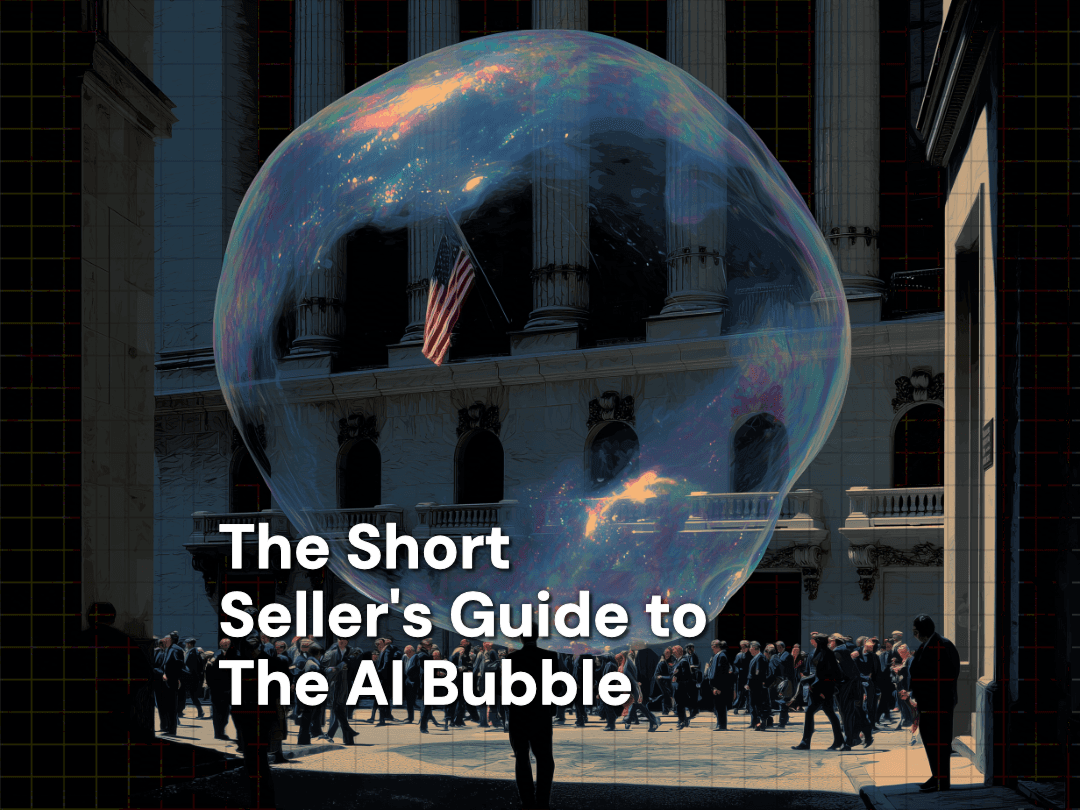
A Short Seller’s Guide to the AI Bubble
From Michael Burry's bearish bets to inverse ETFs and credit default swaps, a comprehensive guide to understanding, and profiting from, the growing case that artificial intelligence is the most overvalued sector in modern history.
Activ8 Newsroom • March 2, 2026
This article was published in February 2026. Markets discussed are actively trading and positions described may have changed since publication. Nothing in this article constitutes financial advice. Readers should conduct their own research before making any investment decisions.
- Michael Burry is betting against AI. The investor who profited from the 2008 housing crash has taken bearish positions against Palantir and Nvidia, calling current AI investment an "escalator to nowhere."[2][3]
- Wall Street is following. The volume of credit default swaps taken out against U.S. tech giants has risen 90% since September 2025, signaling institutional skepticism about AI valuations.[7]
- History rhymes. The AI boom shares structural parallels with Tulip Mania, the dot-com bubble, the 2020 Covid crash, and the 2008 housing crisis — all defined by speculation outpacing fundamentals.
- The numbers don't add up. 88% of businesses have incorporated AI into their workflows, yet only 5% have seen profitability. Only 3% of users pay for generative AI.[10][20]
- Infrastructure costs are unsustainable. Alphabet, Microsoft, Amazon, and Meta are projected to collectively spend $400 billion on AI in 2026 — funded in part by debt — while data centers threaten to consume 12% of U.S. electricity by 2028.[22][24]
- There are ways to position. From direct short selling to inverse ETFs, credit default swaps, and put options, this article outlines how investors can hedge or profit from a potential correction.
Over the past several years, artificial intelligence has moved from the margins of innovation to the center of everyday life. What began with relatively simple chatbots has evolved at a pace few could have anticipated. In less than half a decade, AI has advanced from experimental novelty to a powerful, multi-faceted technology embedded across nearly every aspect of modern society. Seemingly overnight, society has become deeply familiar with AI-driven therapists, image generation, personalized targeting, and virtual assistants. As these technologies continue to expand in capability and influence, a critical question emerges: where does artificial intelligence go from here?
This article provides a comprehensive overview of the state of AI's flawed business model through the lens of a short seller. By understanding the shortcomings of AI and the strategies used to short the bubble, one can either profit from its impending correction or simply hedge against risk.
U.S. Tech Giants Since Sept. '25
AI Spend in 2026
Profitability from AI
Earnings Multiple
The main topic of debate Activ8 aims to evaluate is whether or not the AI Bubble is eligible for shorting. Increasingly, outsiders have recognized that there's insufficient evidence to conclude that the market will indefinitely continue to grow. Rather, the stupendous cost of training new models, environmental unsustainability, and an ever-growing desire for human interaction all point to AI's impending correction. Therefore, a great deal of savvy investors have been using this uncertainty as a means for profit.
One of the most famous investors and hedge fund managers, Michael Burry, is known for his risky bet against subprime mortgages before the 2008 housing market crash. This move earned him about $100 million personally and produced over $700 million for his hedge fund.[1] Looking for the next source of market mispricing, Burry has identified AI as a target.
As a result of his conviction, Burry has bearish bets against Palantir and Nvidia, two leading firms in the AI sector he believes are overvalued.[2] His explanation for his decision has complemented many of the problems with AI that we've previously identified. For one, Burry sees the current business model as unreasonably costly. In a recent Substack exchange, he expressed his concerns over tech giants wasting billions of dollars on microchips and data centers to power chatbots, which he thinks will become commoditized. His comparison of investments in AI to an "escalator to nowhere" is reflective of tech giants like Microsoft, Alphabet, and Nvidia squandering investments on a technology that burns money without a clear path to profitability.[3]
Despite his reservations, there are two things that would change Burry's attitude towards artificial intelligence valuations, one of them involving AI agents displacing millions of jobs at top companies. Another event that would force him to reconsider his short position is an application-layer revenue of at least $500 billion for the AI industry. However, neither of these hypotheticals is likely to happen. One of the aforementioned causes of the unlikelihood of AI agents replacing human workers is the fact that most businesses haven't seen real profitability from incorporating AI into their workflows. Moreover, it's improbable that LLMs generate $500 billion in revenue anytime soon, principally because most users access generative AI for free.[2][3]
Michael Burry is hardly the only relevant investor to voice concerns over AI's trajectory. Even Microsoft co-founder Bill Gates has warned the public that a number of pricy AI stocks can't justify their valuations. He believes that a significant portion of them will lose their value.[4] In addition to Gates, Warren Buffett of Berkshire Hathaway[5] and Torsten Slok of Apollo Global Management[6] have vocalized their own negative predictions for AI's future.
It's also important to note that Wall Street is increasingly shorting artificial intelligence as companies continue to heavily borrow for the sake of AI development. Traders have escalated the amount they're spending on credit default swaps, which are forms of shorts — insurance derivatives that pay out when a company fails. Data from The Financial Times signifies that the volume of credit default swaps taken out against U.S. tech giants has risen 90% since September of 2025.[7] By steadily shorting big tech companies like Oracle and Meta, investors not only create a hedge, but an opportunity to make a profit.
For three years now, the world has been caught on the AI question: is artificial intelligence our future, or an inflated fantasy? We at Activ8 Insights side with the latter argument, as the parallels to historic market bubbles are difficult to ignore. In fact, the state of AI is comparable to four major overcorrections of mispriced assets.
After considering the current shortcomings of the AI Bubble and signs to look out for before the impending burst, it's important to evaluate the methods of shorting or maintaining a long position in AI. Thankfully, there are a few options to facilitate a short position.
The most direct method an investor can employ to short the AI Bubble is by borrowing shares and selling them, then buying them back at a lower price to profit from the decline. We've identified three behemoths in the AI space worth examining: Nvidia (NVDA), Palantir Technologies (PLTR), and Oracle (ORCL).
Nvidia is the most prominent player in the AI space, being the most highly valued firm in the world. Its enormous growth over the past two years has astounded investors. In fact, the stock is up over 40% from a year ago. Historically, Nvidia has been a heavy investor into OpenAI, helping the company to construct more data centers where Nvidia's chips will be used. This has raised eyebrows among investors, seeing as Nvidia is essentially bankrolling one of its biggest customers to inflate demand for its chips. More concerns have been raised over the stock's considerable dip after it was announced that the company's plan to invest $100 billion in OpenAI has stalled, hinting at the fact that much of the tech giant's value derives from funding its major purchaser of chips.[14]
Palantir, another huge name in artificial intelligence, has been cited by Michael Burry to be an excellent choice to bet against.[14] The company is known to create software and data tools for government agencies like the Department of Homeland Security and the Department of Defense. In the past year, Palantir signed a multi-billion dollar deal with the U.S. Army and a $448 million deal with the Navy.[15] Despite these contracts — and the fact that the company beat earnings expectations in the last quarter — Palantir is priced 216 times the company's trailing earnings. Therefore, investors have been increasingly turning away in fear that the company is overvalued.[16]
Oracle is another software developer that has come under fire recently. In the past year, the stock has fallen over 10%, particularly due to lower than expected increases in revenue after taking out billions of dollars in debt to finance AI.[17] Oracle recently announced plans to raise $50 billion from a mix of debt and equity sales to fund its AI buildout.[18] This announcement came after one of their largest bond issuances in September of last year, which was valued at $18 billion. The bond market and investors are weary about the company taking on more debt obligation, and the price of credit default swaps for companies like Oracle have increased.[19]
Major tech companies like Alphabet, Microsoft, Amazon, and Meta are eligible to short as well. However, it should be noted that these firms are riskier to short since they generate steady revenue and aren't as susceptible to stock fluctuations based on AI demand projections. That being said, these four companies demonstrate a similar pattern of investment in artificial intelligence. For example, it's predicted that Alphabet, Microsoft, Amazon, and Meta will collectively spend $400 billion this year on AI, specifically for data center construction.[22] A considerable portion of this capital expenditure will be funded by a mix of earnings and debt. Again, investors have been noting the risk involved in such heavy investments, especially seeing as most companies who employ AI haven't noticed an impact on the bottom line and only 3% of users pay for artificial intelligence.[10]
If you're looking for a more diversified option to short AI, we'd recommend considering a multitude of inverse ETFs, depending on your risk aversion. To clarify, exchange-traded funds are essentially a basket of securities — stocks, bonds, or commodities — that are able to be traded on stock exchanges. ETFs typically track an index or sector, providing simultaneous diversification and liquidity in comparison to mutual funds.
On the other hand, inverse ETFs are an investment tool for shorting. Their value increases anytime a specific industry or sector fails. Some ETFs are leveraged, which aim to generate two or three times the daily performance of the underlying index. And as it relates to AI, the major 2x ETFs are AIBU and AIBD. On the other hand, ETFs like GPTS and TECS provide three times as much exposure.
Additionally, it should also be noted that there are leveraged ETFs that allow investors to take a bearish position in individual corporations without borrowing on margin. These include METD, ORCS, AMZN, GGLS, and MSFD — whose underlying stocks include Meta, Oracle, Amazon, Google, and Microsoft.
Credit default swaps are a type of financial derivative that provides insurance against the risk of a borrower defaulting on debt obligations like a bond or loan. The purchaser of the CDS pays periodic payments and is compensated with a lump sum by the seller if the borrower fails to pay back the debt. Credit default swaps can be purchased by institutional investors from banking institutions like Goldman Sachs, Deutsche Bank, and JPMorgan Chase. However, credit default swaps aren't accessible to retail investors, but individuals can access CDS exposure by purchasing ETFs.
Put options are a form of derivative that's received much attention in the past few years. Essentially a "put" is a contract where an investor buys the right to sell a stock at a specific price. Typically, puts are only exercised when the exercise price is greater than the current stock price, providing insurance against a rapid decrease in stock price. In short, purchasing put options as an owner of the major AI firms discussed would generate a payout if the bubble burst and stock prices steeply declined.
After becoming more familiar with the cloud hovering above the AI Bubble, you may be wondering what factors would signal its eventual correction. After conducting research on the most significant issues facing artificial intelligence, there are four signs to monitor and consider if and when you plan to short the bubble: insufficient revenue, supply shortages, an increase in interest rates, and government regulations.
It's no secret how capital-intensive artificial intelligence can be. Just last month, Meta announced that it would spend up to $135 billion in 2026, much of it going towards AI development.[22] Other frontrunners in the space like Microsoft and Tesla also continue to invest billions of dollars in artificial intelligence. From building data centers to the power needed to produce inferences, the variable cost of these investments is astronomical. This could be overlooked if artificial intelligence generated a substantial amount of annual revenue, but this is not the case.
Take ChatGPT, for example, whose product is publicly available. There may be some users who are willing to pay for their different subscription tiers, but this group is insufficient to cover the growing scaling costs that result from training new models and building more resource-intensive data centers. However, the main problem is that users access generative AI at a price below the cost of what it's worth. And as tech giants continue to funnel billions of dollars into AI without displaying an urgency to effectively increase revenue, shareholder trust in the industry model will only deteriorate more and more.[20]
Artificial intelligence requires an incredible amount of resources, including materials, energy, and labor. Tech companies are scrambling for computer chips that are essential to products outside of data centers, such as phones and computers. Apple recently announced that it's been having trouble buying two types of computer chips for their iPhones and Mac computers. The demand has escalated as AI companies compete for those same chips in their data centers, which has skyrocketed the price of memory chips.[23] There's speculation that these costs will increase the prices of consumer electronics in the near future.
Experts have also expressed anxiety over how hyperscaling will impact the power grid and the cost of electricity. For instance, Meta is constructing a 1.2 million square foot data center in El Paso, Texas, that will draw enormous amounts of energy — enough to power 200,000 households. Currently, data centers consume about 4% of the country's power supply. However, they are projected to consume up to 12% of total U.S. electricity by 2028.[24][25] The rapid scaling of data centers and their consumption of energy undercuts efforts to curb climate change while simultaneously threatening to increase the price of energy in areas where the grid is already stretched thin.
Lastly, data center construction requires a significant workforce of skilled laborers. Anirban Basu, chief economist for Associated Builders and Contractors, maintains that there aren't enough electricians to support both data centers and other major construction like apartment buildings, healthcare facilities, and factories.[26] OpenAI projects that the maintenance and construction of data facilities would require 20 percent of the workforce of skilled workers, including mechanics and electricians.
Uncertainty surrounding interest rates has investors anxious over the enormous capital expenditures being directed towards artificial intelligence. Even though the Trump administration is applying heavy pressure on the Federal Reserve to maintain a low interest rate, the 10-year Treasury yield is a stronger determinant of long-term borrowing costs for businesses and consumers, such as mortgages. Bond yields tend to correspond with the Federal Reserve's benchmark rate — when the Fed cuts interest rates, bond yields will typically also decrease, which essentially lowers the cost of borrowing. However, the bond yield and Fed rate are diverging, hinting that investors are demanding a higher yield in the face of persistent inflation.[27]
The Federal Reserve controls the benchmark interest rate, which influences borrowing costs. Considering the fact that the future is expected to involve trillions of dollars being invested into data center construction, an increasing cost to borrowing should be monitored. There will come a time when the majority of investors grasp the large discrepancy between earnings and valuation for these major companies, which will be unable to justify heavy spending on more artificial intelligence.[19]
Recently, there have been elevated concerns over how truly unsustainable artificial intelligence is for the environment — especially in the wake of efforts to mitigate climate change. The problem is further exacerbated by AI, as the rapid cycle of development of LLMs requires the construction of data centers. These data centers demand large amounts of electricity that is often sourced from fossil fuel-based power plants. In addition to the increasing amounts of energy being used in data centers, water is another resource that is heavily relied on to cool equipment. Cornell researchers have found that by 2030, artificial intelligence will drain 731 to 1,125 million cubic meters of water per year.[28]
More and more, individuals are vocalizing their worries over the ridiculous amounts of energy and water consumed in data centers. Here in the United States, 40% of U.S. adults admit to being "extremely" or "very" concerned about the environmental implications.[29] Interestingly, this is a higher rate of Americans who are concerned about the meat production or travel industries. Given the intensified unease surrounding AI's environmental consequences, it's inevitable that governments or entire communities begin demanding binding regulations that curb ecological disruption. And when this finally happens, one can only conclude that it will impact AI's already fragile bottom line.
Overall, a widening gap has emerged between the practical limitations of artificial intelligence and the idealized narrative surrounding its future. While innovation has been rapid, expectations have outpaced economic reality, leaving investors exposed to a market driven more by optimism than fundamentals. As history has repeatedly shown, periods of speculative excess reward those who question prevailing narratives rather than follow them.
Investors now face a clear choice: continue chasing momentum under the assumption that growth will eventually justify valuation, or recognize the warning signs of mispricing and adjust accordingly. In an environment defined by escalating costs, uncertain profitability, and mounting skepticism, breaking from the herd may prove to be the most rational — and profitable — decision.
More in News

Consolidation Comes to Activist Short Selling
A landmark acquisition, back-to-back collaborative reports, and interviews with investigators point to a shift in how activist short selling gets done.
Activ8 Newsroom • July 7, 2026
The Citron Scorecard: How Andrew Left’s Targets Actually Traded
A great deal has been written about the man. Far less has been written about the numbers. We pulled every Citron Research call in our database and measured what happened to the stocks.
Activ8 Newsroom • June 23, 2026
Activist Short Selling After the Andrew Left Decision: Pt 1
Andrew Left was convicted for trading against his own calls, not for his research, and what the verdict really changes for activist short selling will not be settled until the appeal.
Activ8 Newsroom • June 4, 2026