
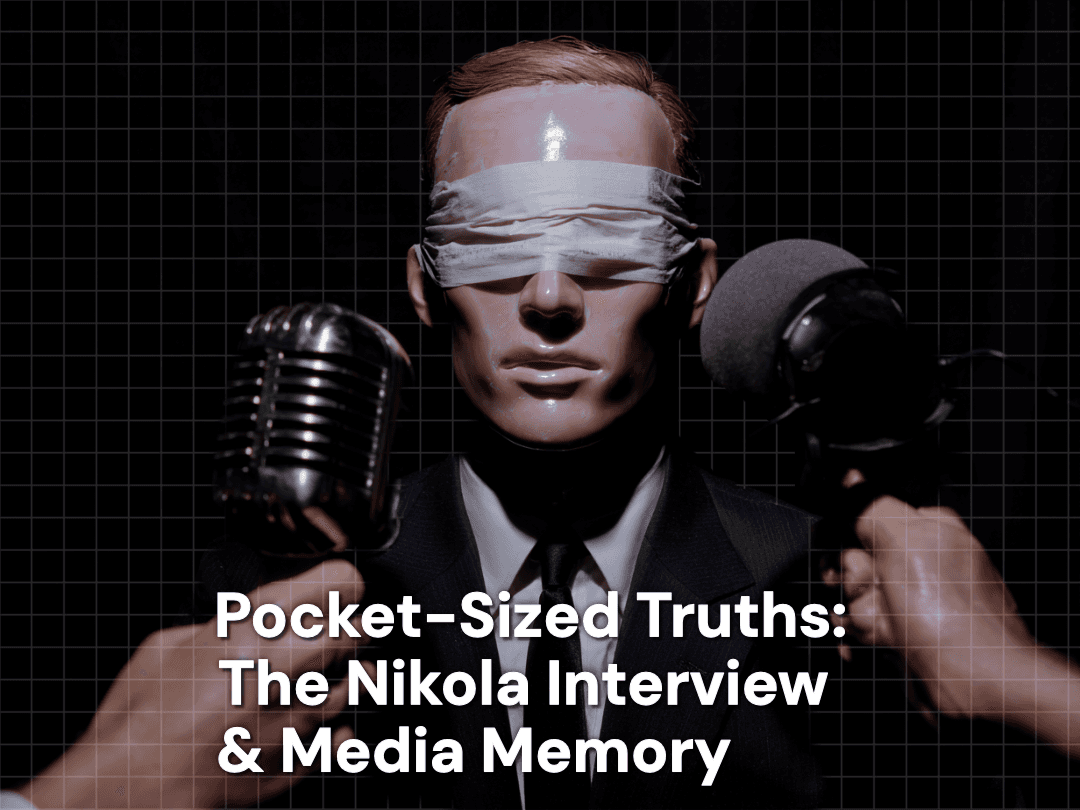
Pocket-Sized Truths: What the Nikola Interview Tells Us About Media Memory
This marks the third article we’ve published examining the evolving media spectacle surrounding Trevor Milton and his recent interview with Tucker Carlson.
Activ8 Newsroom • August 19, 2025
This marks the third article we’ve published examining the evolving media spectacle surrounding Trevor Milton and his recent interview with Tucker Carlson.
In our first piece, Deconstructing Nikola: A Look Back at the Hindenburg Exposé That Changed Everything, we revisited the original short report that brought Milton’s company—and his reputation—into question. In our follow-up, One Confession Ahead of Consequence, we analyzed Milton’s attempt to reframe his downfall through his interview with Carlson.
Now, we turn to the audience’s response—and what it reveals about how media narratives are consumed, distorted, and ultimately remembered.
The Interview and the Algorithm
The interview itself—nearly two hours long—was designed to reshape public perception of Trevor Milton, the convicted former CEO of Nikola Motors. Carlson, acting as a hands-off facilitator, gave Milton space to reframe his legal troubles, portray himself as a victim, and cast doubt on those who exposed him.
At one point, while introducing Hindenburg founder Nate Anderson, Carlson noted how little public information was available about him. At one point Carlson remarked that Anderson had once worked as an ambulance driver in Israel—then moved on. It was a fleeting moment, barely emphasized.
And yet, despite all the effort and airtime, the single most-liked comment on YouTube (as of August 4th) reads:
I am listening and all I am gonna remember is.. Nate Anderson worked as an Ambulance driver in Israel … that is all I heard ..

Out of hundreds of minutes, dozens of claims, and years of legal fallout, this was the takeaway. Not fraud. Not innocence. Not even dispute. Just a passing detail about the man who helped expose the case—repackaged into symbolic shorthand.
This was the final version of a story that had already passed through multiple filters. First, Milton’s—a slow, cinematic retelling that reframed his fraud as misunderstanding. Then the audience’s—a rapid, chaotic remix of half-remembered facts and conspiratorial and antisemitic suggestion. The original record—federal rulings, SEC filings, the conviction itself—was lost in the process. What remained was what could be easily digested, easily shared, and emotionally charged.
What Sticks
It’s tempting to think the audience missed the point. But in truth, the point was never theirs to choose. Out of an hours-long interview—packed with dramatic claims, legal denials, and emotional appeals—the detail that rose to the top wasn’t the fraud, the conviction, or even Milton’s version of events. It was a single, offhand mention of Nate Anderson’s past work as an ambulance driver in Israel. That one line became the story.
This isn’t random—it’s algorithmically selected. Platforms reward what sticks, what provokes, what can be repeated without effort. The comment became a lightning rod, drawing in replies that fit a pattern: vague conspiracies, half-formed accusations, and coded hostility. It wasn’t the complexity of the case that captivated people—it was the simplicity of a detail they could turn into something familiar, something usable.
The facts didn’t disappear. They were simply too cumbersome to survive. In their place was narrative drift—a collective reinterpretation shaped not by evidence, but by what felt true and familiar.
The Short Seller as Scapegoat
Short sellers often provide the kind of story the public craves: a villain, a fall, and the feeling that someone is finally being held to account. In cases like Nikola—or Adani, or others—short-selling reports have generated headlines, trended online, and driven major consequences. But the same dynamics that can make a short-seller’s report go viral can just as easily turn against them. The moment the narrative feels too complex, too clinical, or too threatening to belief, the audience looks for someone else to blame.
In this case, Hindenburg’s report wasn’t ignored—it was repositioned. Anderson became a stand-in for everything the audience wanted to resist: expertise, facts, and accountability. The focus shifted from Milton’s actions to Anderson’s background. And the facts—however real, however proven—were forced to compete with a faster, easier story. The result wasn’t just misdirection. It was narrative inversion, where the exposer of fraud becomes the object of suspicion.
A Microcosm of Modern Media
After all the filings, all the headlines, and nearly two hours of stage-managed conversation, what lingered wasn’t fraud or accountability—it was an ambulance driver in Israel. A minor detail became the narrative’s anchor, not because it mattered, but because it was easy to grasp. It stuck. It stirred. And the algorithm rewarded it.
The saga of Nikola became a microcosm of how media functions today—a story filtered again and again: through Hindenburg’s investigation, Milton’s retelling, the audience’s interpretation, and finally, the algorithm’s amplification. What remained wasn’t context or consequence. It was a pocket-sized fragment—small enough to carry, simple enough to feel like understanding.
Pocket-sized truths like this offer something more than comfort. They offer a way to explain the hard-to-understand truths and the absurdities of the world.
We live in a world where truth competes with virality—and often loses.
More in News

Consolidation Comes to Activist Short Selling
A landmark acquisition, back-to-back collaborative reports, and interviews with investigators point to a shift in how activist short selling gets done.
Activ8 Newsroom • July 7, 2026
The Citron Scorecard: How Andrew Left’s Targets Actually Traded
A great deal has been written about the man. Far less has been written about the numbers. We pulled every Citron Research call in our database and measured what happened to the stocks.
Activ8 Newsroom • June 23, 2026
Activist Short Selling After the Andrew Left Decision: Pt 1
Andrew Left was convicted for trading against his own calls, not for his research, and what the verdict really changes for activist short selling will not be settled until the appeal.
Activ8 Newsroom • June 4, 2026