
Short Selling in a Bull Market
The market spends roughly two-thirds of its time in an uptrend, and short sellers who look like geniuses during a crash often spent the preceding three years barely surviving. The best Investigators do not fight bull markets, they use them to research, document, and map the dislocations between price and fundamentals that will define the next thesis.
Activ8 Newsroom • April 28, 2026
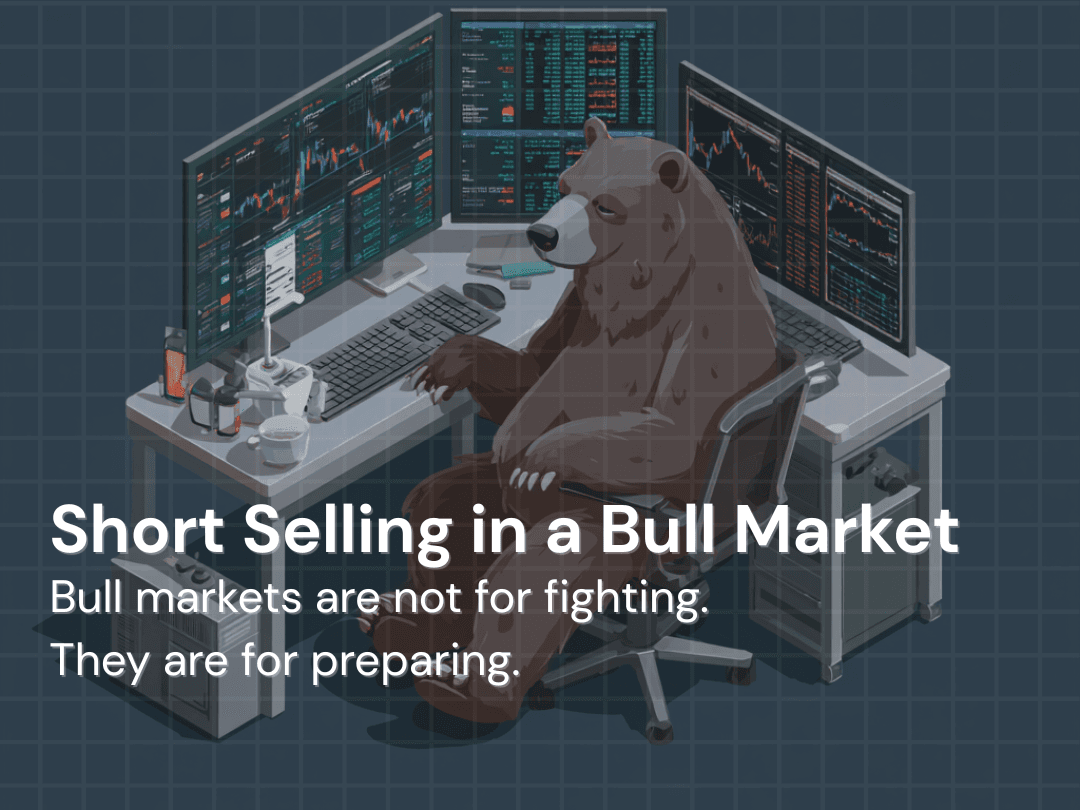
- Bull markets are not for fighting, they are for preparing. The market spends roughly two-thirds of its time in an uptrend, with bull markets averaging 9.1 years versus 1.4 years for bears. The best Investigators use rallies to research, document, and map dislocations between price and fundamentals.
- The AI narrative effect proves how stretched the rubber band has become. Allbirds (BIRD) traded as high as $24.31 intraday on April 15, 2026 (an 876% move from the prior close), and MYSE surged more than 300% then closed down 40% on the same day. Neither company's fundamentals materially changed.
- Insider selling pace and timing matter more than the fact of selling itself. When a stock rises 200% and executives systematically unwind positions every quarter, the divergence between public messaging and private behavior becomes a documentable thesis.
- The technical landscape can destroy a correct thesis. Short interest above 20%, borrow costs of 30% or more annualized, and concentrated call gamma can turn a fundamentally broken stock into a dangerous trade. Squeezes represent only 0.40% of all stock-day observations, but they wipe out positions when they hit.
- There is no prize for being first. When a Fugazi Research or Muddy Waters Research report drops, the initial move overshoots. Watching the company's response, whether it addresses allegations or attacks the messenger, often reveals more than the report itself.
Don't Fight the Tape. Keep Receipts.
On April 17, 2026, the Nasdaq Composite logged its 13th consecutive positive session, the longest winning streak since January 9, 1992. The Composite posted its largest three-week gain since April 2020.
 In moments like this, short sellers tend to disappear from the conversation. They are dismissed as perma-bears who missed it again. They can even be brutally humiliated during extreme short squeezes. Volkswagen in 2008 briefly became the world's most valuable company as short sellers scrambled to cover. GameStop in 2021, immortalized in the film Dumb Money, saw retail traders on Reddit collectively corner a heavily-shorted name and send it from $20 to nearly $500 in days. Painful as these events are, they represent only about 0.40% of all stock-day observations.
But the dismissal misses something important: the best Investigators are not fighting the tape right now. They are taking notes. In fact, bull markets are, counterintuitively, one of the best research environments to find major dislocations between current price and true value.

Livermore, who won and lost multiple fortunes and made $100 million shorting the 1929 crash, understood that timing was the variable most likely to destroy you. Not conviction. Timing. The market is always right about where it is. The question is whether you can afford to wait for it to agree with where you think it is going.
The Asymmetry of Cycles
Before anything else, it is worth sitting with a simple visual fact about markets.
The market spends roughly two-thirds of its time in an uptrend. Short sellers have the odds stacked against them the majority of the time. Those who look like geniuses during a crash often spent the preceding three years barely surviving. Their thesis may have been correct all along. But unfortunately, there is no prize for being early in trading, which is frequently indistinguishable from being wrong.
Bull markets are not a period to fight. They are periods to prepare.
Measuring the Rubber Band
One of the defining features of a sustained bull market is that it keeps things alive that probably should not be. Companies with deteriorating fundamentals, declining margins, and fragile business models, what eventually get called "zombie companies," can trade at elevated valuations for years when the broader tape is rising and capital flows freely. During a run, they are not called zombies. They are called growth stories, optionality plays, or platforms in the early innings. The market grants them access to capital at terms that reflect optimism about a future that may never materialize. We call these Hollow Companies: businesses that should have run aground but stay afloat as long as the tide is rising.
The gap between narrative and fundamentals can widen considerably before it closes, and a short seller who enters too early pays the full carrying cost of that gap. Bull markets are where narratives outrun reality most dramatically. An Investigator's job during a run is not to call the top. It is to document exactly how far a story has drifted from the numbers underneath it. The wider that gap gets, the more compelling the eventual thesis. You are not timing the trade. You are measuring the rubber band.
The moment conditions shift, whether rates rise, sentiment sours, or one missed quarter removes the benefit of the doubt, the market stops granting charity to unprofitable stories. The Investigator who already mapped the fundamentals carefully during the stretch enters with an enormous advantage over the crowd discovering the thesis for the first time on the day of the breakdown.
The rest of this article outlines what that preparation actually looks like: the specific patterns and signals that sophisticated Investigators catalog during periods of rampant euphoria. Not because they are pessimistic about the future, but because bad companies inevitably get swept up alongside good ones in the latest hot trend, and the divergences between price and reality become more pronounced and more documentable as the bull runs longer.
What to look for in the AI narrative. How insider behavior reads differently when stocks are near all-time highs. How to understand the technical squeeze landscape before you need to trade through it. And when, finally, the moment to act arrives, how to enter with discipline.
The AI Narrative Effect
No recent bull market theme illustrates the narrative-versus-fundamentals tension more vividly than the AI pivot wave. A company's willingness to describe itself as AI-focused became, in many cases, sufficient to produce a multi-hundred-percent price move regardless of whether anything about the underlying business had changed.
Consider Allbirds (BIRD), the direct-to-consumer shoe manufacturer. On April 14, 2026, BIRD closed at $2.49, a small-cap name with a well-documented history of declining margins. The following session, news of an AI-focused strategic pivot drove the stock to gap at $6.82 (+174%), with intraday trading reaching $24.31, an 876% move from the prior close, before settling to $10.80 by April 17. Did the underlying fundamentals change? Not materially. What changed was the market's willingness to grant the company a future it had not yet earned.
A second example arrived almost simultaneously. MYSE surged more than 300% on April 16, 2026 on AI-focus news, and closed the same session down 40%. The entire thesis played out in a single trading day.
The Investigator watching these moves is not frustrated by them. They are cataloging them. If anything, these events underscore how uttering the two-letter word "AI" can destroy short positions in the short term while ultimately changing nothing about the underlying business. More importantly, they reveal the dislocation between what is being promised and what the cash flow statement actually reflects. The rally in BIRD was not a signal that footwear economics had changed. It was a signal about how far the market was willing to stretch in the direction of narrative, and how quickly it snapped back. Each episode like this is a data point about where the current froth is concentrated, and how quickly the gap closes when reality reasserts.
Insider Behavior vs. Price Action
Of all the signals available to an Investigator, insider transaction patterns may be the most systematically underappreciated, and a bull market is the best environment to document them. To be fair: not all insider selling is a warning sign. Executives and directors have mortgages, personal investment goals, and concentrated positions that any prudent financial advisor would recommend diversifying. Selling shares in a company that has done well is often just good personal financial management. That is entirely legitimate.
What is worth scrutinizing is the pace and timing. When a stock rises 200% and insiders are selling every quarter, systematically and not occasionally, the divergence becomes more visible, not less. In a declining market, selling might be attributed to liquidity needs. In a bull market, when a stock is near all-time highs and executives are collectively unwinding positions at an accelerating rate, they are making a specific statement about their own confidence in the narrative they are still publicly promoting. The Investigator who builds this dossier during the bull run has a timestamped paper trail when the thesis eventually plays out. That documentation is the difference between a thesis and a rumor.
- Form 4 filings. Director and officer transactions, required within 2 business days of execution.
- 10b5-1 plan activity. Pre-planned sales that bypass blackout periods. Clusters of activity across multiple executives are meaningful.
- CFO tenure and departure signals. Finance chief exits near quarter-end often precede earnings surprises.
- Multiple C-suite exits in a short window. Two or more departures within 90 days warrants scrutiny, especially if departures are framed as "to pursue other opportunities."
Timing Is Everything: Short Squeezes
High conviction does not automatically translate into a tradeable position. A stock can be fundamentally broken (deteriorating earnings quality, a departing CFO, balance sheet stress accumulating) and still be a dangerous short because of its technical profile. Crowded short interest, punishing borrow costs, and retail momentum amplified by options gamma can create conditions where a correct thesis produces catastrophic short-term losses before it eventually pays out. GameStop was not an anomaly. It was an extreme version of a risk that exists in every heavily-shorted name.
The right use of a bull market, for an Investigator, is to map this landscape before you need it. Which thesis names have short interest above 20%? Which carry borrow costs that erode the position over time? Which are prone to gamma-driven squeezes when call open interest is concentrated near key strikes? This is homework, not a trade.
Related to this: you do not have to be the first one in. When a major short report is published, whether a Fugazi Research or Muddy Waters Research release, the initial move is violent and almost always overshoots. The company responds. The stock partially recovers. A narrative war begins. The sophisticated late entrant gets to watch this play out and ask the only question that matters: does the company's response actually address the core allegations, or does it merely create noise around them? Companies that respond by attacking the messenger, issuing vague reassurances, or announcing investigations that quietly conclude with no findings are, in most cases, confirming the thesis. The second leg down, when the initial spike fades and fundamentals reassert, is often cleaner and more sustained than the day-one drop. There is no prize for being first.
When the Time Comes: Acting on the Thesis
Everything described in this article (mapping the fundamentals, cataloging insider behavior, understanding the squeeze landscape) is preparation. At some point, conditions change. The thesis begins to play out. The question is how to act on it when the moment arrives.
The signal to begin testing a position is rarely a single event. It tends to be a convergence: an earnings call where management is unable to answer direct questions about the metrics you have been watching; a quarter where the gap between reported income and cash flow widens further; a CFO departure that follows a pattern you documented six months ago. These are not coincidences. They are the fundamentals you already understand beginning to surface in public-facing data.
When that convergence appears, how you act on it matters as much as the thesis itself. Your size and your timing are your greatest safety levers. A bull market that stretched the rubber band for two or three years built in genuine squeeze risk, elevated borrow costs, and a narrative that still has defenders. The research you did during that period, mapping the technical landscape, understanding who the retail participants are, knowing exactly which metrics are most likely to surface in a public catalyst, is what allows you to move carefully rather than reactively when the moment arrives.
If new information changes the picture, whether a genuine strategic pivot, a credible new management team, or a capital raise that actually solves the structural problem, the thesis changes too. Price alone is never the arbiter. The underlying facts are. That clarity, built over months of preparation during the bull, is the only thing that makes acting on the thesis survivable when the time finally comes.
Inside the Activ8 Dashboard
The themes in this article are not abstract. They map directly to measurable data signals that exist in financial filings, price history, and corporate records, and they do not wait for bear markets to become relevant. The fundamental metrics below are tracked inside the Activ8 Insights dashboard across more than 3,700 stocks: names that have received formal short reports, and the much larger universe of names that have not, where the fundamentals may be quietly deteriorating long before anyone is paying attention.
| Theme | What to Watch For | Activ8 Signal |
|---|---|---|
| Hollow CompaniesZombie cos kept alive by cheap capital | Structural cash burn, repeated equity raises, debt maturities approaching | Balance Sheet Stress |
| Coordinated Insider SellingMultiple executives selling in a 30-day window | Cluster of Form 4 transactions across two or more insiders within 30 days; signals shared expectation of near-term price weakness | Governance |
| Insider Ownership ChangeNet insider buying or selling over twelve months | Cumulative shares bought and sold by insiders over a trailing twelve-month window; persistent net selling at elevated prices is one of the cleanest behavioral signals available | Governance |
| Business DecayStructural deterioration masked by bull market | Revenue quality declining, gross margin erosion, operating leverage going negative | Business Decay Score |
These signals are updated every quarter, tracked 252 trading days a year. The rubber band does not disappear in a bull market. It just gets more stretched, and more measurable.
Sources & Notes: Nasdaq 13-consecutive-day winning streak as of April 17, 2026. Bull and bear market statistics based on S&P 500 total return data. Recession periods: National Bureau of Economic Research (NBER). Short squeeze frequency (0.40% of stock-day observations): Yahoo Finance research. Allbirds (BIRD) price data: April 14 to 17, 2026. MYSE price action: April 16, 2026. Jesse Livermore quote from Edwin Lefèvre, Reminiscences of a Stock Operator (1923). Volkswagen 2008 short squeeze academic analysis: Allen, Haas, Nowak & Tengulov (2021), "Market Efficiency and Limits to Arbitrage: Evidence from the Volkswagen Short Squeeze," Journal of Financial Economics 142(1): 166–194.
Disclaimer: The information provided on Activ8Insights.com, including all articles, reports, commentary, and associated content, is intended solely for informational and educational purposes. It does not constitute investment advice, an offer, or a recommendation to buy or sell any securities. All views and opinions presented aim to promote transparency and critical dialogue around activist investing, particularly short activism, and should not be interpreted as personalized financial advice. Investors are solely responsible for their own due diligence and investment decisions, based on publicly available information and their individual financial circumstances. Contributors to or affiliates of Activ8Insights may hold long or short positions in the securities mentioned. These positions may change at any time without notice, and there is no obligation to disclose such changes after publication. Any market data listed is data at the most recent market close. Market data may be delayed or changed after publication on Activ8Insights.com.
More in News

Consolidation Comes to Activist Short Selling
A landmark acquisition, back-to-back collaborative reports, and interviews with investigators point to a shift in how activist short selling gets done.
Activ8 Newsroom • July 7, 2026
The Citron Scorecard: How Andrew Left’s Targets Actually Traded
A great deal has been written about the man. Far less has been written about the numbers. We pulled every Citron Research call in our database and measured what happened to the stocks.
Activ8 Newsroom • June 23, 2026
Activist Short Selling After the Andrew Left Decision: Pt 1
Andrew Left was convicted for trading against his own calls, not for his research, and what the verdict really changes for activist short selling will not be settled until the appeal.
Activ8 Newsroom • June 4, 2026