
The Informant Economy
How U.S. government whistleblower programs quietly became one of the most powerful forces in activist short selling, and why a new Treasury expansion is about to make that relationship more complicated.
Activ8 Newsroom • April 2, 2026
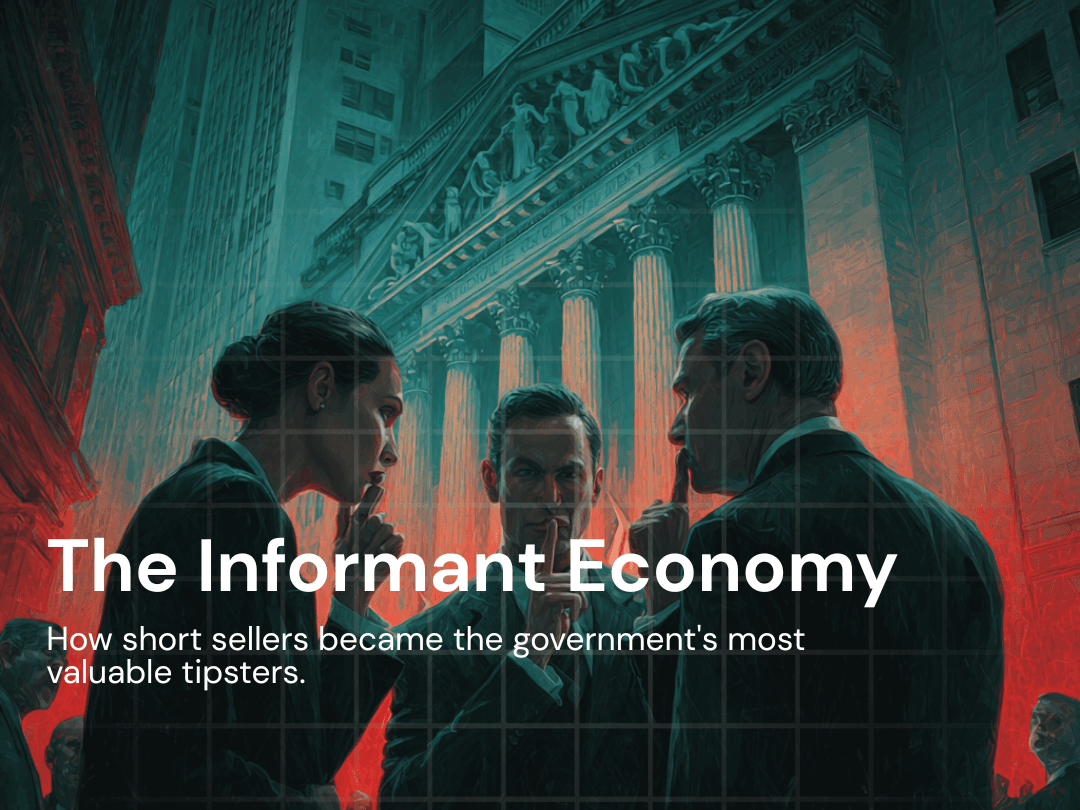
- $2.2 billion paid. Since the SEC whistleblower program launched in 2012, the agency has awarded more than $2.2 billion to 444 individuals, creating a financial incentive structure that now shapes how investigative research is conducted and shared.
- Activist short sellers are documented participants. Research using FOIA data found that outside parties broadly, including investors, analysts, and industry professionals, account for roughly 40% of recent awards by count. Activist short sellers are a confirmed and significant subset of that group, though the SEC's data does not break down what share is attributable to them specifically.
- The government is expanding the model. In February 2026, the Treasury Department launched a new FinCEN whistleblower portal covering fraud, money laundering, and sanctions violations, extending the reward-for-tips framework beyond securities law for the first time at this scale.
- The arrangement raises conflict-of-interest questions. Critics argue that paying short sellers to inform on companies they are already betting against creates perverse incentives. Defenders counter that the research is being done regardless, and the tips produce real enforcement outcomes.
- For Investigators, the stakes are rising. As whistleblower programs expand and attract more scrutiny, the legal and reputational environment for activist short sellers is shifting in ways that could benefit careful operators and disadvantage careless ones.
The U.S. government has long relied on insiders to expose financial fraud. What has taken longer to acknowledge is that some of its most valuable informants hold short positions in the very companies they are reporting on, and that for more than a decade, federal regulators have been paying them for it.
The SEC's whistleblower bounty program, created in the wake of the 2008 financial crisis and the Madoff scandal, has quietly become one of the defining institutions of modern financial markets. It has paid out more than $2.2 billion to 444 individuals since launching in 2012 [3]. It has generated enforcement actions that recovered billions more. And according to research using Freedom of Information Act data, it has made activist short sellers, the Investigators who publish public research on companies they believe are overvalued or fraudulent, into some of the program's most significant contributors. [4]
Now the government is expanding the model. On February 13, 2026, the Treasury Department's Financial Crimes Enforcement Network, known as FinCEN, launched a new whistleblower portal under 31 U.S.C. §5323, inviting tips on Bank Secrecy Act violations, sanctions evasion, and money laundering. The statute provides for awards of 10-30% of monetary sanctions collected, funded through a new "Financial Integrity Fund." Implementing regulations are still pending, meaning tips are accepted but awards cannot yet be paid, but the policy infrastructure is now in place. [1] [2] [8]
The convergence of these two developments, the maturation of the SEC program and the new Treasury expansion, is reshaping the environment in which activist short sellers operate. Understanding how, and why, matters for anyone who follows this space.
How the Programs Work
The SEC whistleblower program was created under the Dodd-Frank Wall Street Reform and Consumer Protection Act of 2010, with formal rules taking effect in 2012. The mechanics are straightforward: any individual who voluntarily provides the SEC with original, credible information that leads to a successful enforcement action, meaning sanctions of more than $1 million, is eligible for an award of between 10% and 30% of the money collected. [3]
The program is funded entirely through monetary sanctions paid by securities law violators. In theory, it costs the government nothing. In practice, it has become a significant financial institution in its own right. The single largest award in program history was nearly $279 million, paid to one whistleblower. In fiscal year 2024, the agency awarded $255 million to 47 individuals, including one split award of approximately $98 million paid to two whistleblowers whose combined tips drove enforcement actions by the SEC and other agencies. [7]
The FinCEN program, announced in February 2026, operates through a different legal framework rooted in 31 U.S.C. §5323, as amended by the Anti-Money Laundering Act of 2020 and the Anti-Money Laundering Whistleblower Improvement Act of 2022. Where the SEC and CFTC programs cover violations of securities and commodities laws, the new FinCEN portal targets violations of the Bank Secrecy Act, the International Emergency Economic Powers Act, the Trading With the Enemy Act, and the Foreign Narcotics Kingpin Designation Act. These are statutes that govern the financial system's role in preventing money laundering, sanctions evasion, and illicit finance. [2] [8]
One critical detail, buried in the program's own documentation: FinCEN has not yet finalized the implementing regulations needed to begin paying awards. Tips submitted now will be accepted and shared with enforcement partners, including the Treasury's Office of Foreign Assets Control and the DOJ's Money Laundering and Narcotics section, but whistleblowers cannot collect payments until the rule is published. [2] That caveat does not diminish the program's significance as a policy signal, but it matters for anyone trying to understand the timeline.
Investigators as Government Informants
The most provocative finding to emerge from academic research on the SEC whistleblower program is not how much money it has paid out. It is who has been collecting it.
Alexander Platt, an associate professor at the University of Kansas School of Law, published research in 2024 drawing on FOIA data from the SEC. His finding: all outside parties combined, a category the SEC defines to include investors, industry professionals, analysts, and competitors, account for about 40% of awards issued by the program in the most recent years for which data is available (FY2020 and FY2021). [4] Cumulatively through FY2022, outsiders had collected nearly $300 million from the program, representing more than a third of all awards by count. Activist short sellers are a confirmed and significant subset of that outsider category, though the SEC's data does not isolate their specific share. What Platt's research does establish, through case-by-case documentation, is that many of the most prominent Investigators in the space have been participating actively and successfully.
Cumulative dollar totals via FOIA. In FY2020 and FY2021, outsiders received ~40% of awards by count, up from a historical average of ~31%. The SEC stopped disclosing the insider/outsider breakdown after FY2021. [4]
The best-documented cases involve household names in the Investigator world, and none more so than Carson Block of Muddy Waters Research.
In November 2011, Block published a report alleging that Focus Media, a NASDAQ-listed Chinese digital advertising company valued in the billions, had been fraudulently overstating the number of screens in its LCD network by approximately 50%, had claimed to acquire companies it never actually purchased, and that firm insiders had earned at least $70 million in fraudulent transactions. [4] The report was not a casual tip. It drew on months of work by a team of researchers involving review of thousands of pages of regulatory filings and extensive on-the-ground fieldwork in Thailand and China. Following publication, Focus Media's stock lost two thirds of its value. The SEC opened an investigation, which ultimately led to a $55 million settlement and the company's delisting from Nasdaq. [4]
Block did eventually receive a $14 million whistleblower award from the SEC for the Focus Media work, but the path was not straightforward. The SEC initially denied his claim on a technicality -- he had not submitted information on the agency's required official form at the time. Block appealed. The Commission exercised its discretionary authority to waive the requirement given what it called the "unusual facts and circumstances" of the case, and issued the award. The payment came in March 2022, more than a decade after the original report. [4]
The Focus Media case illustrates precisely what defenders of activist short seller participation in the whistleblower program argue: Block did not simply fire off a tip and wait for a check. He committed significant capital, assembled a research team, conducted original fieldwork, and produced a report detailed enough to form the backbone of a federal enforcement action. The decade-long wait for payment, and the bureaucratic hurdle he had to appeal to clear, is not the profile of someone gaming a system for easy money.
David Einhorn of Greenlight Capital received a separate award of undisclosed size for his 2010 short of The St. Joe Company, a Florida real estate firm whose properties Einhorn alleged were significantly overvalued on its balance sheet. Nathan Anderson of Hindenburg Research, before shutting down operations in early 2025, had made as many as 25 separate whistleblower submissions to the SEC on public companies, private companies, and private funds. [4]
What makes Platt's research particularly significant is what it reveals about how Investigators engage with the program. Short sellers are not merely submitting tips and walking away. According to Platt's research, well-financed outsider tipsters often go far beyond providing factual evidence, supplying the SEC with legal analysis, expert reports, witness lists, and in some cases draft pleadings. This is work that traditionally would have been performed by SEC staff. [4]
In some instances, Investigators have also recruited insider tipsters to participate in the program, in some cases offering trading profits in exchange for cooperation. [4] The boundary between financial journalism, market research, and law enforcement collaboration has, in practice, become porous.
The data on activist short sellers and the SEC whistleblower program comes from "The Shortseller Enrichment Commission?", a 2024 paper by Alexander Platt of the University of Kansas School of Law, published in the Washington Law Review (Vol. 99). Platt used FOIA requests to obtain dollar-level insider/outsider breakdowns the SEC stopped disclosing after FY2021, combined those with SEC annual report data, and conducted interviews with activist short sellers and whistleblower lawyers. The paper documents award participation by Carson Block, Nathan Anderson, David Einhorn, Kyle Bass, Marc Cohodes, Bill Ackman, and others. It is the most detailed public accounting of the program's overlap with the activist short selling industry to date. [4]
The Privatization Debate
Not everyone is comfortable with what has emerged. The arrangement, where private investors profit first from shorting a stock then collect government bounties for reporting the same misconduct, strikes some observers as a structural conflict of interest.
Platt himself frames the concern carefully. He describes the SEC whistleblower program as having effectively become an outsourcing arrangement: the agency uses the program to pay private professionals to do work that previously would have been done by SEC staff, amounting to the equivalent of roughly 12% of the SEC's enforcement budget in recent years. [4] His concern is not that the tips are false, as many have led to genuine enforcement outcomes, but that the financial incentives may distort behavior in ways that are difficult to observe or regulate.
The conflict-of-interest issue is structural. An Investigator who has shorted a stock and filed a whistleblower tip has financial incentives that point in only one direction: they benefit if the company is investigated, if the stock declines, and if the enforcement action results in sanctions large enough to trigger a bounty. Under current program rules, the SEC does not deduct the tipster's trading profits when calculating awards, meaning an Investigator who earned millions by shorting a target could still collect a full percentage-based federal bounty on top. [4]
Short sellers also point to a significant asymmetry in how the arrangement is discussed publicly. When Investigators publish research, they face regulatory scrutiny, legal challenges from targeted companies, and market risks. When their work leads to enforcement actions, the government collects billions in sanctions. That the Investigators share modestly in that outcome, through bounty awards that typically represent a small fraction of total sanctions, is, in their view, reasonable compensation for the risk taken. [5]
What It Means for Investigators
The expansion of government whistleblower programs into new domains, combined with increased academic and media scrutiny of the SEC program, creates a more complex operating environment for activist short sellers. Several dynamics are worth watching.
Platt's research notes that receiving a federal whistleblower award, which requires the SEC to validate both the substance of the tip and the tipster's eligibility, may help insulate Investigators from the legal and regulatory attacks that have increasingly become a tool of targeted companies. [4] A firm that has been paid a federal bounty for its research on a company is in a different legal position than one that has merely published a report.
Platt and others have argued that the SEC should require Investigators to disclose their trading profits when calculating award eligibility, and that the agency should be more transparent about the proportion of awards going to professional outside tipsters versus inside whistleblowers. [4] Any such changes could alter the economics of the arrangement significantly.
The Treasury Department has built statutory infrastructure under 31 U.S.C. §5323 to compensate private informants across a wider range of financial crimes. For Investigators whose research touches on sanctions violations, money laundering, or BSA-adjacent conduct, particularly in international markets, the program represents a meaningful future channel once implementing regulations are finalized. [2] [8]
For now, the relationship between government enforcement and private short selling research remains one of the least examined dynamics in markets. It is also, the data suggests, one of the most financially significant.
Sources
- [1] U.S. Department of the Treasury. "Treasury Accepting Whistleblower Tips on Fraud, Money Laundering, Sanctions Violations." Press Release SB0394, February 13, 2026. home.treasury.gov
- [2] Financial Crimes Enforcement Network (FinCEN). "Treasury Whistleblower Program." Launched February 2026. fincen.gov
- [3] U.S. Securities and Exchange Commission. "Office of the Whistleblower: Fiscal Year 2024 Annual Report to Congress." sec.gov
- [4] Platt, Alexander I. "The Shortseller Enrichment Commission?: Whistleblowers, Activist Short Sellers, and the New Privatization of Public Enforcement." 99 Washington Law Review (2024). Draft via SSRN: ssrn.com/abstract=4744972. Summarized at Harvard Law School Forum on Corporate Governance, April 15, 2024: corpgov.law.harvard.edu. FOIA dollar data obtained directly from SEC (letter Dec. 7, 2022).
- [5] Institutional Investor. "Activist Short Sellers Are the SEC's Biggest Whistleblowers." institutionalinvestor.com
- [6] Schneier, Bruce and Nathan Sanders. "The SEC Whistleblower Program Is Dominating Regulatory Enforcement." The American Prospect, October 18, 2024. prospect.org
- [7] National Law Review. "Overview of Top SEC Whistleblower Awards of 2024." natlawreview.com
- [8] U.S. Code, Title 31, Section 5323. "Whistleblower incentives and protections." As amended by the Anti-Money Laundering Act of 2020 (Pub. L. 116-283) and the Anti-Money Laundering Whistleblower Improvement Act of 2022 (Pub. L. 117-328). uscode.house.gov
More in News

Consolidation Comes to Activist Short Selling
A landmark acquisition, back-to-back collaborative reports, and interviews with investigators point to a shift in how activist short selling gets done.
Activ8 Newsroom • July 7, 2026
The Citron Scorecard: How Andrew Left’s Targets Actually Traded
A great deal has been written about the man. Far less has been written about the numbers. We pulled every Citron Research call in our database and measured what happened to the stocks.
Activ8 Newsroom • June 23, 2026
Activist Short Selling After the Andrew Left Decision: Pt 1
Andrew Left was convicted for trading against his own calls, not for his research, and what the verdict really changes for activist short selling will not be settled until the appeal.
Activ8 Newsroom • June 4, 2026